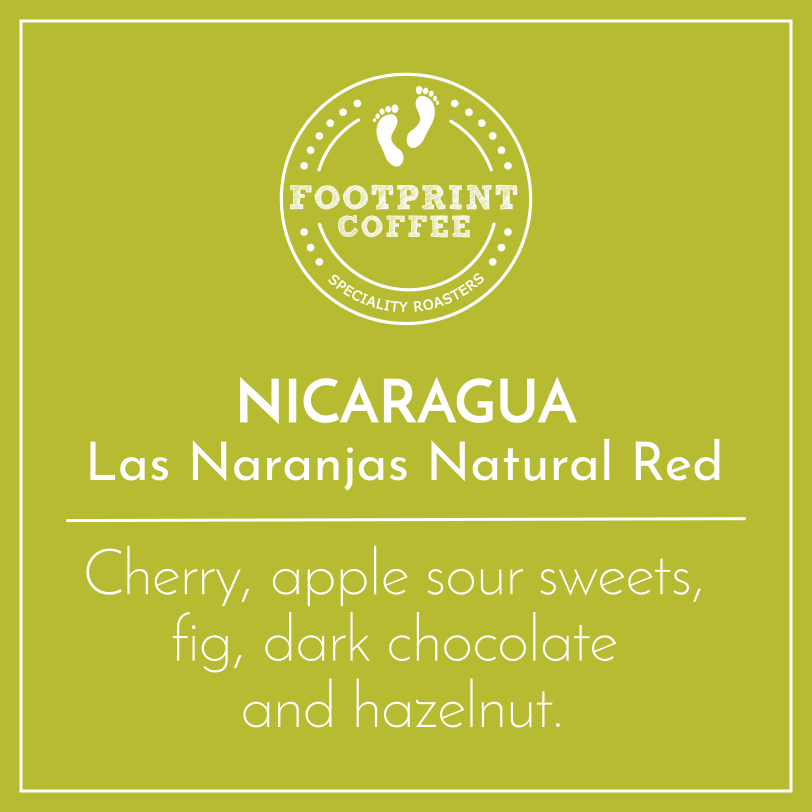
Nicaragua
Origin
Nicaragua
Process
Natural
Sizes
227g, 900g
Nicaragua – Las Naranjas Natural Red Cafetos de Segovia, established in 2015 by sisters Ana and Martha Albir Sotomayor, represents the third generation of a family deeply rooted in coffee farming in Nicaragua. Their mission was to process and export high-quality coffee from their farms and other local estates. Today, the cooperative boasts over 40 seasonal workers, including 19 women from the Mozonte region, and employs eight permanent staff members. Annually, Cafetos de Segovia exports 6,000 quintals of coffee (approximately 272,500 kilograms). The main office is located at Km 231, Carretera Ocotal – Jalapa, 300 meters north of Ramamesa, Mozonte, Nueva Segovia, Nicaragua. The cooperative includes Finca Agua Sarca, Finca El Naranjal, and Finca Santa Helena. The cooperative provides its members with technical assistance, continuous quality improvement training, and financial support for farm enhancements and harvest estimates. They hold HACCP certification under the Nicaraguan Institute for Agricultural Protection and Health (IPSA), ensuring the highest standards of sanitary and phytosanitary measures. Las Naranjas farm is named for the once-abundant orange trees on the property. Owned by Juan Carlos Herrera Lpez since 1970 as a family inheritance, the farm is located 500 meters west of Finca Santa Gema in El Pinabete, Los Arados, Mosonte, Nueva Segovia. Spanning 3.9 hectares, the farm yields an average of 12 quintals of coffee per hectare. The farm sits at an altitude of 1380 to 1450 meters and cultivates Catuai rojo, Catuai Amarillo, Catimor, and Caturra varieties on sandy loam soils. The harvest season extends from December to April. Las Naranjas employs one permanent worker and hires five additional workers during the harvest and processing periods. The Las Naranjas lot is cultivated at altitudes between 1450 and 1550 meters on a 3-hectare plot. The farm uses eco-friendly practices, providing shade with forest species, fruit trees, and bananas. Low-intensity pesticides (green labels), organic fertilizers, and synthetic fertilizers are utilized. Regular pruning and shade management improve plant health, and only ripe cherries are manually harvested. After selection, the cherries are floated and depulped, then fermented for 18 to 24 hours before being washed with clean water. The coffee is transported in plastic bags and macen sacks to the processing facility, ensuring cleanliness throughout the journey. At the dry mill, the coffee is dried on African bed
from